How We Delivered Digital Skills Training for Refugees in Kenya and Turned 80 Closing Doors Into Open Ones
An eight-week programme that moved displaced youth from basic digital exposure to market-ready work and measurable income outcomes.

Executive Summary
Refugees and displaced youth in Kenya face a uniquely difficult labour market: limited legal work rights, gaps in formal education, and near-total exclusion from the digital economy that increasingly defines where global opportunity now lives.
Our client set out to change that for 80 young people across two cohorts, and needed a delivery partner capable of building real, market-ready digital competency in just eight weeks, with measurable employment outcomes attached. Adept designed and delivered a digital skills training programme for refugees in Kenya, achieving a 97% completion rate and converting more than half of all graduates into income-generating digital work within six months.
The Client
Our client was an international humanitarian organisation operating across some of the world's most complex displacement contexts, supporting refugees and host communities in building sustainable, dignified livelihoods. In Kenya, the client worked with refugee and host-community populations who face structural barriers to formal employment, documentation constraints, interrupted education, and a labour market that often has little room for those without an established local track record.
The Challenge: Digital Exclusion Is Not a Skills Gap. It's an Economic Cliff Edge.

For displaced youth and refugees in Kenya, exclusion from the digital economy carries very real consequences. Without a pathway into remote, freelance, or digital-enabled work, these young people face entrenched unemployment, prolonged dependency on humanitarian assistance, and the kind of economic precarity that aid organisations spend years trying to reverse.
Digital and remote work, freelancing, online data work, remote customer support, digital marketing, represents one of the few labour markets genuinely accessible regardless of legal work status, nationality, or physical location. Refugee livelihoods programmes increasingly recognise this as a scalable pathway. But that door only opens for young people who have the skills, the credibility, and the connections to walk through it.
The youth and refugee populations our client serves had little to no prior digital exposure beyond basic phone literacy. Many had interrupted formal education. Trust in any new programme was low, a population repeatedly let down by short-lived interventions does not extend good faith to a new training initiative by default. And critically, our client needed a delivery partner who could not simply teach digital skills in a classroom, but who could build a credible bridge from training to actual paid work.
"Digital inclusion in Africa starts with one decision: choosing a delivery partner accountable for outcomes, not just outputs."
Our Approach
We designed and delivered a structured 8-week Digital Skills Training (DST) programme built specifically around the realities of the client's target population, combining theoretical grounding with hands-on practice and sustained mentorship.
Curriculum Design: A custom-built curriculum spanning digital literacy fundamentals, freelancing and online work readiness, data entry, and digital marketing, sequenced to build confidence before complexity.
Applied Learning: Practice-led sessions rather than passive lecture formats, ensuring participants left each session with a demonstrable, applied skill.
Mentorship: Structured mentorship pairing throughout the programme, directly addressing the trust and confidence gap that purely academic training cannot solve.
Certification: Formal certification on completion, giving participants a credible credential to present to potential employers and freelance clients.
Outcome Tracking: Rigorous progress tracking and outcome reporting to the client throughout, surfacing performance trends and early employment outcomes in real time, not only at programme close.

Execution and Delivery
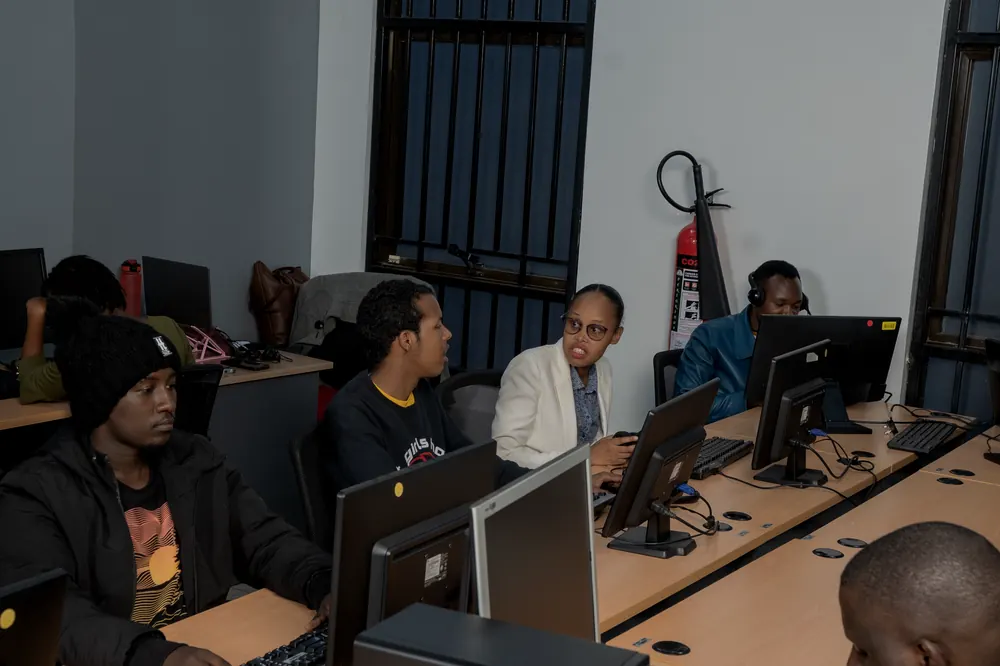
The programme was delivered across two cohorts, September to November 2022, and September to November 2023, with 40 learners per cohort. Each cohort ran the full 8-week structure, blending classroom-style instruction with practical, project-based work that mirrored the kind of tasks participants would encounter in real freelance or remote-work settings. Adept maintained a 95% participation rate throughout, with consistent attendance becoming an early indicator of the trust the programme had built with a population that does not extend trust easily.
"The collaboration advanced digital inclusion and employability for youth and refugees. Graduates have since secured remote work, contract roles, and freelance projects, directly contributing to DRC's sustainable livelihoods mission."— Danish Refugee Council, Programme Partnership Review
The Results
80 total participants across two cohorts, with 60% women, a meaningful figure in a context where displaced women often face compounded barriers to economic participation. A 97% completion rate and 95% participation rate is evidence that the programme design successfully overcame the trust and engagement barriers that typically undermine training interventions in displaced populations. An average trainee grade of 82% demonstrates genuine skill acquisition rather than passive attendance. More than 50% of graduates transitioned into income-generating digital work within six months of completion, with average post-training earnings of $100, a transformative figure for participants previously locked out of formal income entirely. 10 graduates were absorbed directly into Adept's own internal projects, converting training success into immediate, tangible employment.
The Impact
This engagement did more than deliver a digital skills training programme for refugees, it created a working, replicable model for converting digital exclusion into digital economic participation for one of the most structurally disadvantaged populations in Kenya's labour market.
For our client, the results provided concrete, fundable evidence that a targeted youth employability Kenya intervention can move the needle on long-term livelihoods outcomes, not just short-term training metrics. For the 80 participants, the impact is measured in something more immediate: income, dignity, and a foothold in a digital economy that was previously closed to them entirely.
"Impact sourcing in Kenya is not a theory. For 80 young people, it became a monthly income."
The Bigger Picture
Kenya hosts one of the largest refugee populations in East Africa, and the question of how displaced communities access sustainable livelihoods sits at the centre of humanitarian and development policy across the region. This is precisely the kind of high-stakes, outcomes-accountable work that demands a specialist delivery partner. Not a generic training vendor.
Frequently Asked Questions
How does digital skills training help refugees access employment in Kenya?+
Adept designed and delivered a custom 8-week Digital Skills Training programme combining digital literacy, freelancing readiness, data entry, and digital marketing with structured mentorship, achieving a 97% completion rate across 80 participants in two cohorts.
What employment outcomes resulted from the digital skills programme?+
More than 50% of graduates transitioned into income-generating digital or freelance work within six months of completing the programme, with average post-training earnings of $100.
Why is digital work an effective livelihoods pathway for refugees?+
Digital and remote work platforms are largely accessible regardless of legal work status, nationality, or location, making them one of the few scalable employment pathways for displaced populations facing traditional labour market barriers.
Designing a livelihoods programme that needs to prove real outcomes?
Talk to us at adept-techno.com