Use resources responsibly
Consider energy, materials and waste in the way we operate and design digital services.
ENVIRONMENTAL, SOCIAL & GOVERNANCE
At Adept Technologies, the way we deliver matters as much as the work itself. Our approach to ESG connects responsible operations, opportunity through digital work, and the trust our clients place in us.
As an African technology and business services partner, we see a practical connection between business growth and shared progress. Digital transformation can expand access to services, help people build skills and create employment. Delivering that value also means considering our environmental footprint, treating people fairly and making accountable decisions.
These priorities guide our work across contact centre services, software development, human-in-the-loop AI and business automation. Our policies provide the detail behind this approach, from protecting information to maintaining quality and using AI responsibly.
Consider energy, materials and waste in the way we operate and design digital services.
Connect digital skills, inclusive participation and dignified work with real business needs.
Bring ethics, quality, privacy and human accountability into everyday delivery.
ENVIRONMENTAL RESPONSIBILITY
Technology has an environmental footprint, even when the work is digital. Equipment, energy use and the handling of materials all deserve attention. Our environmental focus is on practical resource stewardship and considering how the services we deliver can support more efficient ways of working.
Our priorities include reducing avoidable printing, using equipment responsibly and considering reuse and appropriate disposal when devices reach the end of their useful life. These are areas for ongoing improvement as our operations grow.
Digital records and streamlined workflows can reduce reliance on paper and unnecessary movement of physical documents. We consider these opportunities alongside accessibility, security and service quality, so that efficiency supports the people using the service.
Our focus is continuous improvement in resource use. Environmental benefits should be assessed in context; digitisation alone is not evidence of a measured reduction in emissions.
SOCIAL RESPONSIBILITY
People are central to the services we deliver. We believe in fair and dignified work, inclusive employment and practical pathways into the digital economy. Impact sourcing brings these priorities together by connecting business demand with opportunities for people who face barriers to employment.
Training has the greatest value when people can apply it. Our work connects digital skills with delivery environments, helping participants develop the capabilities needed for transcription, digitisation and other technology-enabled services.
Our community programmes include young people, women, and refugee and host communities. Creating access means considering the barriers people face, the support they need to participate and how learning can lead to income-generating opportunities.
Within our teams, responsible delivery depends on clear expectations, training and support. Quality and ethical conduct are shared responsibilities, with people equipped to understand the work, identify concerns and improve how services are delivered.
COMMUNITY & IMPACT
Our existing programme experience shows how digital transformation and employment creation can reinforce one another. The examples below describe individual programmes, rather than annual ESG performance totals.



Under Kenya’s Ajira Digital Program, Adept designed and managed transcription and digitisation workflows, established operations across multiple locations, and recruited and trained young people to support the Judiciary’s digitisation journey. The young people were trained by the International Trade Centre (ITC).
The programme combined access to digital court records with practical experience and employment opportunities for young people.
In partnership with the Danish Refugee Council, Adept delivered an eight-week digital skills programme for 80 young people from refugee and host communities in Kenya. The programme recorded 97% completion, with women representing 60% of participants. More than half transitioned into income-generating digital work within six months.
Read the case study →Future Link and Code Future provide practical digital-skills initiatives that help young people build capabilities for the digital economy. We piloted Future Link in Kibera, a community close to our hearts, and what we learned there shapes how we run the programme today.
Read a trainee’s story →Developed with Kalsoon, Digital Safety for Girls combines a bilingual English/Somali web platform and a WhatsApp bot to make digital-safety education more accessible to girls in Northeastern Kenya, with privacy considered in the design.
See our case studies →ETHICS & GOVERNANCE
Clients entrust us with their operations, information and reputation. Good governance brings that responsibility into everyday decisions: how we agree requirements, manage risks, protect information and respond when something needs to improve.
We maintain a zero-tolerance approach to corruption, bribery and unethical conduct. Employee training and clear expectations support responsible behaviour in our relationships with clients, colleagues and partners.
Our quality approach connects client requirements with defined processes, review and corrective action. Consistent delivery depends on people understanding their responsibilities and acting on feedback, rather than treating quality as a final check.
Data protection is part of this responsibility. Access to information, handling practices and security controls need to reflect the work being undertaken and the sensitivity of the data involved.
RESPONSIBLE TECHNOLOGY
AI and automation can improve services and create new possibilities. Responsible adoption means considering their effects on people, the information they use and the decisions they influence. Our approach connects AI use with existing quality, privacy and security controls.
Human-in-the-loop work brings review and judgement into AI workflows. Clear requirements, careful data preparation and evaluation help teams identify errors and assess whether outputs are suitable for their intended use.
Responsible AI involves asking what data is needed, how it is protected, where bias or harm may arise and when human review is necessary. These considerations belong in the design and delivery process, alongside technical performance.
Our Responsible AI guidance provides more detail on the principles that inform the development, adoption and use of AI within Adept and in the solutions we deliver.
Explore Responsible AI →COMMITMENTS & PROGRESS
Our ESG approach connects with the UN Global Compact principles across human rights, labour, environment and anti-corruption. Our digital-skills and employment initiatives also connect most directly with the following Sustainable Development Goals.
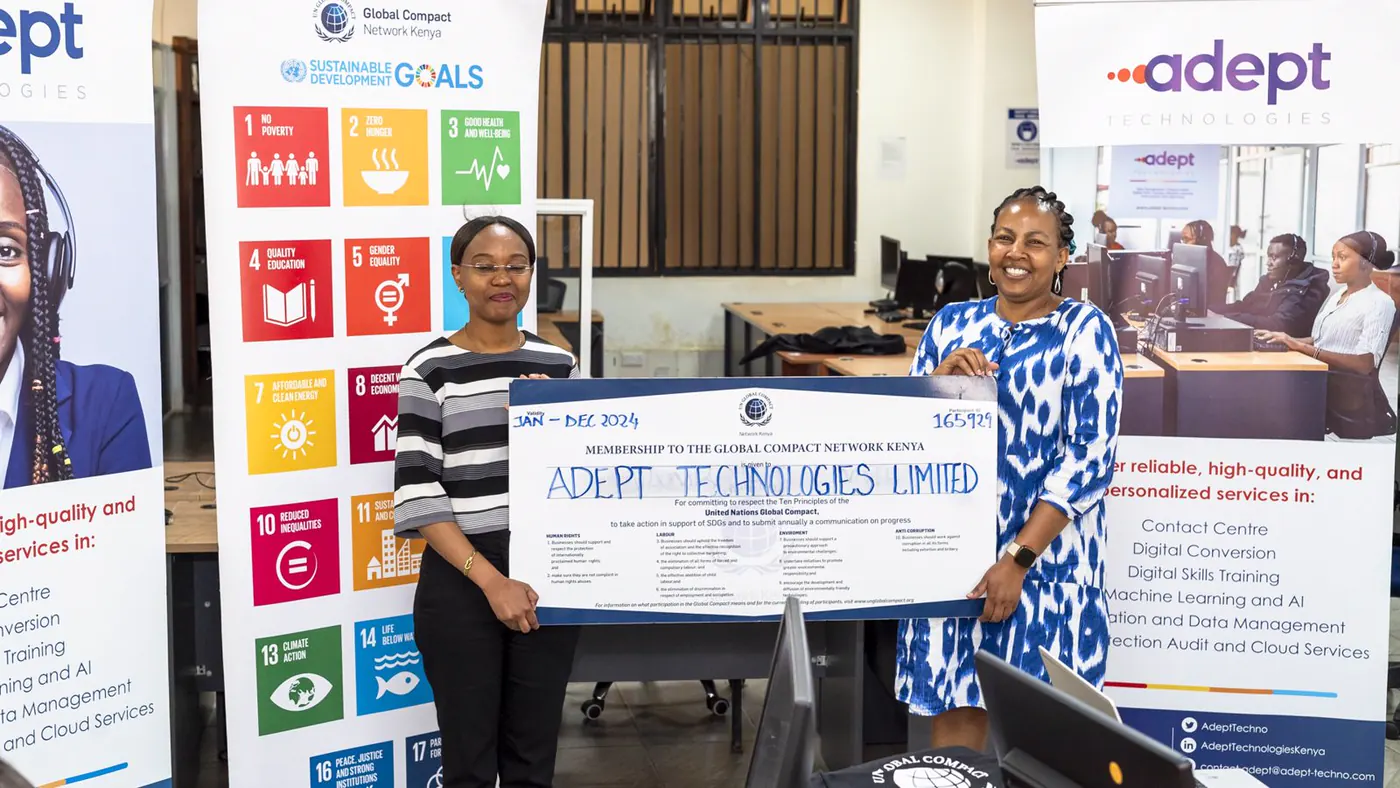
 Adept Technologies Limited receiving its Global Compact Network Kenya membership.
 SDG 4 · Quality Education
 SDG 5 · Gender Equality
 SDG 8 · Decent Work & Economic Growth
These connections give context to our priorities. They do not replace the need to understand programme outcomes, listen to participants and clients, and review how our operations can improve.
Training, reviews, feedback and corrective action help us strengthen delivery. As our approach develops, the priority is to connect commitments with clear responsibilities and evidence, distinguishing programme results from future ambitions.
View our UN Global Compact profile ↗QUESTIONS
Talk to us about your delivery requirements, ESG priorities and the policies that support our work.
Contact our teamWhatsApp us