How We Scaled AI to Help Reduce Food Waste Worldwide
High-quality image annotation helped a food-waste technology company improve its AI and scale actionable insight worldwide.

The Client
Our client is a food waste analytics pioneer that uses AI and automation to help restaurants and hospitality chains worldwide measure, analyze, and reduce food waste across their operations. Through devices installed at food waste points, they capture images continuously across hundreds of outlets in more than 20 countries, generating tens of thousands of images daily. That data powers actionable insights for food-service operators trying to cut costs, reduce waste, and meet sustainability commitments. Their value proposition rests entirely on the quality of what their AI model sees, which is exactly what makes their data problem so consequential.
The Challenge: An AI Model Only as Good as Its Worst Label
Every food waste image captured across every restaurant in every country arrives differently — different lighting, different angles, different cuisines, different containers, different cultural contexts for what 'waste' even looks like. When those images are fed into an AI model without consistent, accurate annotation, the model doesn't just perform poorly, it learns to perform poorly. Every bad label is a lesson the model internalizes and repeats, at scale, across every future inference.
For our client, operating across 20+ countries and accumulating tens of millions of images, this wasn't a theoretical risk. It was an active bottleneck dragging on accuracy, slowing insight delivery, and threatening their ability to expand. Their AI model faced:
- Reduced accuracy across regions and cuisine types due to inconsistent labelling standards.
- Slower processing times that delayed the near-real-time insights restaurants depended on.
- Difficulty scaling to new geographies without a reliable annotation pipeline that could keep up.
- Customer satisfaction risk as delayed and inaccurate reports undermined trust in the platform.
The strategic need was clear: a partner who could convert raw, chaotic, globally diverse food waste imagery into clean, structured, AI-ready data — fast, consistently, and at a volume that matched the client's pace of growth. Not a one-time project. A dependable, long-term capability.
Our Approach

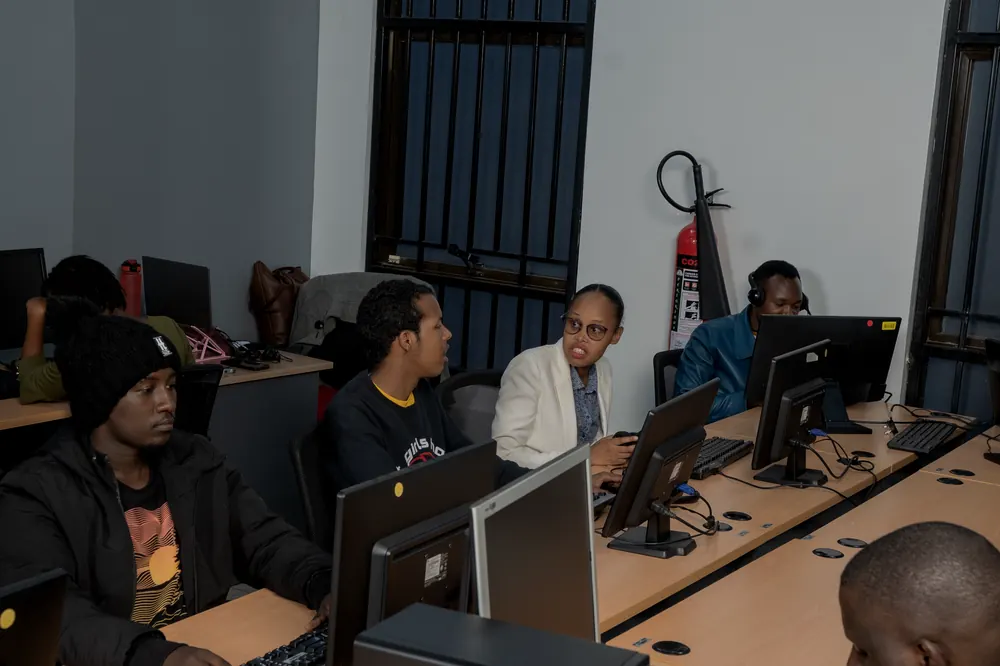
Adept deployed a specialist annotation team trained specifically in food waste classification and image interpretation — not generic data entry, but domain-specific expertise that understood the difference between cuisine types, waste stages, container formats, and the visual nuances that make a label meaningful rather than merely present.
- Annotation scope: Food type identification across hundreds of cuisine categories and regional variations.
- Temporal tracking: Recognition of waste composition changes over time within the same outlet.
- Quantification: Weight and quantity estimation from images, converting visual data into measurable waste volume.
- Global consistency: Consistent classification standards applied uniformly across every geography and data source.
- Volume and velocity: Rapid turnaround pipelines matching the velocity of incoming data from hundreds of active outlets.
The Result
| Area | Before Adept | After Adept |
|---|---|---|
| Annotation consistency | Variable across regions and annotators | Uniform standards applied globally |
| Model accuracy | Reduced by inconsistent labels | Significantly higher across all geographies |
| Insight delivery speed | Delayed by data processing bottlenecks | Near-real-time insights to restaurants |
| Geographic expansion | Constrained by annotation capacity | Scaled to Americas, Australia, UAE |
| Customer satisfaction | At risk from delayed, inaccurate reports | Strengthened through reliable performance |
The Impact
-
AI model performance
With structured, high-fidelity annotated data, the client's AI model began performing at significantly higher accuracy levels across countries and cuisines. Better data meant better decisions for every restaurant on the platform.
-
Faster insights, happier customers
The annotation bottleneck removed, the client could now deliver near-real-time insights to restaurants, directly improving customer satisfaction and the operational credibility of the platform.
-
Global expansion unlocked
From a European base, the client expanded into the Americas, Australia, and the UAE. Each new geography required annotation expertise that could handle its specific cuisines, contexts, and waste categories. Adept scaled with them.
-
530+ tonnes of avoidable waste saved
Better model performance translated directly into better waste reduction recommendations. Cumulatively, 530+ tonnes of avoidable food waste are estimated to have been saved through model-driven interventions and customer action — a measurable sustainability outcome that sits at the core of the client's mission.
-
A six-year partnership, still evolving
What began as an annotation engagement became a strategic data partnership. Adept remains embedded in the client's AI development cycle, evolving alongside their model and their ambitions.
Frequently asked questions
How does AI help reduce food waste in restaurants?
AI platforms analyze food waste images captured at disposal points to identify waste types, quantities, and patterns. Restaurants use these insights to adjust purchasing, portion sizes, and menus, reducing waste and cutting costs.
Why is annotation quality critical for AI food waste models?
An AI model learns from the labels it is trained on. Inconsistent or inaccurate annotations teach the model to make the same errors repeatedly at scale, reducing accuracy and undermining the insights delivered to end users.
How did Adept Technologies support the client's global expansion?
Adept provided high-volume, high-accuracy food waste image annotation across 20+ countries, enabling the client's AI model to perform consistently across diverse cuisines and geographies, directly supporting expansion into the Americas, Australia, and the UAE.
Need a Reliable AI Annotation Partner?
Talk to us about building the data pipeline that powers your model's next leap.
Talk to us at adept-techno.com